On 12-January, 2026 the PACMAN team presented a final project results webinar hosted by Dr. Terence Robinson/Cornell University. Below are the presentation titles and authors (with direct links to individual presentations), or YouTube playlist of the presentations here: https://www.youtube.com/playlist?list=PLYLbxsK4pTXVQ41ysqOtIGBhBlqrWsyFt
It’s a wrap. Really! But we suspect you will see more of and value in precision apple cropload management coming to an orchard near you (maybe yours?) in the near future. You can’t afford not to…
• Intro to PACMAN – Dr. Terence Robinson, Cornell University
Note: All growers are warmly invited to participate in a nationwide PACMAN (Precision Apple Crop Load Management) webinar featuring nationally renowned scientists. After more than five years of scientific research and ground-truth evaluations, the latest PACMAN results will be presented.
The webinar will also highlight new research directions and provide opportunities for collaboration as we plan the next phase of the PACMAN project in the coming years.
Don’t miss this chance to learn about cutting-edge technologies and strategies that can help improve crop load management and orchard efficiency.
Agenda
11:00-11:10am: Introduction to SCRI-PACMAN project – Terence Robinson, CU
11:10-11:30am: Optimum bud and fruit number of HC and Gala – Terence Robinson, CU
11:30-11:50am: Economics of thinning HC and Gala – Mauricio Guerra, CU
11:50-12:30pm: Fruit Growth Rate Model results – Todd Einhorn, MSU; Tom Kon, NCS
12:50-1:10pm: Pollen Tube Growth Model improvements – Greg Peck, CU
1:10-1:30pm: Engineering Results – Long He, PSU
1:30-2:00pm: GPS and Variable Rate Spraying – Brian Lawrence, Yu Jiang, CU
2:00-2:20pm: Extending the results of PCLM – Jon Clements, UMass
2:20-2:40pm: Discussion
2:40-3:00pm: Future SCRI proposal to continue PCLM – Yu Jiang and Terence Robinson, CU
What Has PACMAN Delivered for U.S. apple growers?: Over the past several years, the USDA-SCRI PACMAN (Precision Apple Crop Load Management) project has brought together scientists, extension educators, growers, and ag-technology partners to address one of the most challenging aspects of apple production: managing crop load precisely to achieve consistent yields, good fruit size, high quality, and strong return bloom.
PACMAN has advanced both the science and on-farm practice of crop load management and helped move apple production towards a more data-driven, season-long approach.
Crop load is a season-long decision: One of PACMAN’s most important outcomes has been redefining crop load management as a continuous process, not a one-time thinning decision. The project identified four critical stages for evaluating crop load: (1) Dormant bud number, (2) Bloom density, (3) Fruit set and early fruitlet development, and (4) Final fruit number and fruit size.
This framework helps apple growers make earlier and lower-risk decisions, especially in seasons with variable weather and uneven bloom.
Stronger Physiological Understanding: PACMAN improved our understanding of how bud load, bloom density, fruit set, and carbohydrate balance interact to determine final fruit size and return bloom. Research confirmed what some U.S. growers already observed in the field: early decisions strongly influence fruit size uniformity, packout, and next year’s crop. Fruit growth rate measurements and carbon balance concepts have helped refine thinning timing and expectations.
Digital Imaging Tools: What Works and What Doesn’t: A major focus of PACMAN was the evaluation of digital imaging technologies, including ground-based systems and drones, to count and map buds, blooms, and fruit. Trials in commercial orchards showed that: (1) No system is error-free due to canopy structure and occlusion, (2) Imaging tools are effective at showing orchard- and tree-level trends, (3) These tools greatly improve speed and spatial coverage compared to manual counts.
For U.S. growers, the key takeaway is that imaging does not replace experience – but it can support better, more targeted decisions.
Understanding Orchard Variability: PACMAN demonstrated that crop load varies significantly: (1) Withing individual trees, (2) Between trees, and (3) Across blocks.
Recognizing this variability opens the door to precision management, including targeted pruning, selective hand thinning, and improved labor allocation-especially important given rising labor costs.
Variable-Rate Thinning and Precision Sprays: PACMAN showed that crop load information can guide variable-rate chemical thinning and other precision spray applications. This reduces the risk of over- or under-thinning, improves fruit size consistency, and helps limit unnecessary chemical use – an important consideration for growers.
Models and Field Data Working Together: The project linked fruit growth models, carbon balance concepts, and field measurements with digital data. This integration improved confidence in early thinning decisions, particularly in challenging years when weather conditions affect thinning response.
Strong University-Extension Collaboration: PACMAN’s success was driven by close collaboration among scientists, extensionists, growers, and ag-tech entrepreneurs. Research trials were conducted in research stations and commercial orchards, and results were shared in real time through winter meetings, field days, Zoom webinars, newsletters, and on-farm demonstrations.
What PACMAN Has Made Clear: PACMAN also clarified current limitations. Digital tools are not yet “plug-and-play” for every orchard, and grower expertise remains essential. However, the project clearly showed that precision crop load management is achievable and improving.
Bottom Line for Growers: PACMAN has helped move U.S. apple production from reactive thinning to proactive, precision-based crop load management. As technologies continue to evolve, the PACMAN framework will remain central to improving orchard efficiency, fruit quality, and long-term profitability.
Poster presentation and abstract, Great Lakes Fruit Workers 2025 Meeting, Grand Rapids, MI. November 2025.
For the third growing season in a row in 2025, I partnered with Outfield Technologies (outfield.xyz) using Unmanned Aerial Vehicles (DJI drones) to map apple orchard blossom density and crop load. Using an upgraded drone (Mavic 3M), flights and mapping were done in three states: Massachsetts, New Hampshire, and Minnesota. Flights were done during bloom (bloom variability), early summer (fruit count), and pre-harvest (calibrated fruit count), although not all flights were done at all timings in all orchards. Mapping was refined down to within panel (between posts) granularity over approximately 30 acres of orchard blocks including Honeycrisp, Gala, SweeTango, Evercrisp, Macoun, Ambrosia, Ludacrisp, and Cripps Pink varieties. Although the “So what?” question is not fully anserwed here, within panel variability mapping is a tool that makes variable rate spraying, hand thinning, and harvest management decisions in-turn making precision apple crop load management more plausible. Thanks to Precision Crop Load Management of Apples: USDA-NIFA-SCRI SREP 2020-51181-32197 and Massachusetts Fruit Growers’ Association to make this demonstration possible.
When Gemini asked to summarize current tab (linked page above):
The document you are viewing, “Precision Crop Load Management for Apples,” is a project report detailing a multi-state research effort funded by the National Institute of Food and Agriculture (NIFA).
The main points of the summary are:
Goal: To improve the economic profitability of apple production by developing precision crop load management (PCLM) tools. This involves moving beyond expensive, imprecise manual and chemical thinning methods.
Approach: The project uses a systems approach that integrates plant physiology, crop management, computer vision, robotics, economics, and extension to give growers the ability to accurately calculate and achieve an optimal fruit number per tree.
Key Technological Accomplishments:
Models: Development of a universal Pollen Tube Growth Model (PTGM) and a fruitlet size distribution model to predict final fruit set and guide chemical thinning decisions.
Vision/Robotics: Collaboration with commercial technology companies (e.g., Outfield, Vivid Machines) for field-testing machine vision systems (drones, cameras) to count reproductive structures.
Automation: Development of an unmanned ground robot for data acquisition and 3D modeling of apple trees, along with robotic end-effectors for branch cutting and fruit pulling.
Economic Findings: Research determined that the optimum crop load to maximize profit is approximately 9 fruits/cm² TCA for ‘Gala’ and 8 fruits/cm² TCA for ‘Honeycrisp’.
Outreach: Results are disseminated through the project website PACMAN.extension.org (listed in the document’s content) and through numerous presentations at winter fruit schools, field days, and industry conferences.
The project is currently in its final year, with a projected end date of August 31, 2025.
DISCLAIMER: Not necessarily approved or endorsed by PACMAN
Cropload management is the major must for peak orchard profitability, and a critical, season-defining responsibility of the modern orchard manager. For generations this was achieved through good horticulture plus trial-and-error PGR (plant growth regulator) applications at optimal timings, all couched in the grower’s knowledge of their own block history. Now, in just the last few decades, every aspect of apple production has gone through a process of microscopy that has allowed precision to creep into our vocabulary, not just as a theoretical goal, but as a mathematical destination. Rootstocks have greater dwarfing characteristics, trees have gotten smaller, densities have gotten tighter, canopies have decreased in depth.
Hussain, M., He, L., Schupp, J., Lyons, D. and Heinemann, P. 2023. Green fruit segmentation and orientation estimation for robotic green fruit thinning of apples. Computers and Electronics in Agriculture, 207, p.107734. https://doi.org/10.1016/j.compag.2023.107734
Long He, PhD.
Abstract Apple is a highly valued specialty crop in the U.S. Green fruit thinning is an important operation of apple production, which is the removal of excess fruitlets in the early summer. The task ensures that remaining fruits at harvest time grow to have good size and quality while reducing the risk of biennial bearing. Current methods of thinning include hand, chemical, and mechanical. However, hand thinning generally requires a large labor force to implement, chemical thinning is non-selective and dependent on timing and weather during application, and mechanical thinning is also non-selective and destructive. A robotic green fruit thinning system could possibly be implemented that does not exhibit the drawbacks of current methods. A vision system is an essential component for a robotic green fruit thinning system that is responsible for green fruit detection and segmentation, decision-making on which fruit to remove, and environment reconstruction for path planning. This study took the first step towards developing a vision system for robotic green fruit thinning. First, green fruit and stem instance segmentation was applied using Mask R-CNN. Then, green fruit and stem orientation estimation was applied using Principal Component Analysis (PCA). Average precision scores for green fruit and stem segmentation on all mask sizes were 83.4% and 38.9%, respectively, whereas these increased to 91.3% and 67.7% if only considering the fruits and stems with mask sizes greater than 322 pixels. Green fruit orientation estimation with correction made 89.3% and 75.5% of estimates accurate within 30° of actual orientations for ground-truth and segmentation-generated masks, respectively. Performances respectively were 97.4% and 84.0% when only unoccluded masks are considered. Orientation correction resulted in considerable improvements in all cases of green fruit orientation estimation, with the greatest improvement seen on unoccluded ground truth masks where estimates accurate within 30° of ground truth orientations increased by 23.9%. Stem orientation estimation achieved very high accuracies with corresponding scores of 99.8% and 99.7%. The outcomes provided guideline information for developing a robust machine vision system for robotic green fruit thinning.
Tian Qiu, Tao Wang, Tao Han, Kaspar Kuehn, Lailiang Cheng, Cheng Meng, Xiangtao Xu, Kenong Xu, and Jiang Yu Plant Phenomics, 8 May 2024, Vol 6, Article ID: 0179 DOI: 10.34133/plantphenomics.0179
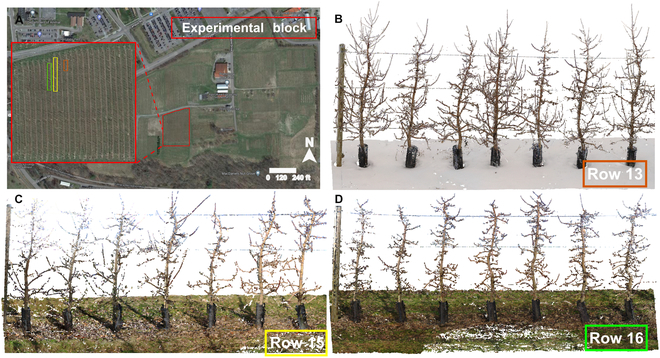
Abstract The architecture of apple trees plays a pivotal role in shaping their growth and fruit-bearing potential, forming the foundation for precision apple management. Traditionally, 2D imaging technologies were employed to delineate the architectural traits of apple trees, but their accuracy was hampered by occlusion and perspective ambiguities. This study aimed to surmount these constraints by devising a 3D geometry-based processing pipeline for apple tree structure segmentation and architectural trait characterization, utilizing point clouds collected by a terrestrial laser scanner (TLS). The pipeline consisted of four modules: (a) data preprocessing module, (b) tree instance segmentation module, (c) tree structure segmentation module, and (d) architectural trait extraction module. The developed pipeline was used to analyze 84 trees of two representative apple cultivars, characterizing architectural traits such as tree height, trunk diameter, branch count, branch diameter, and branch angle. Experimental results indicated that the established pipeline attained an R2 of 0.92 and 0.83, and a mean absolute error (MAE) of 6.1 cm and 4.71 mm for tree height and trunk diameter at the tree level, respectively. Additionally, at the branch level, it achieved an R2 of 0.77 and 0.69, and a MAE of 6.86 mm and 7.48° for branch diameter and angle, respectively. The accurate measurement of these architectural traits can enable precision management in high-density apple orchards and bolster phenotyping endeavors in breeding programs. Moreover, bottlenecks of 3D tree characterization in general were comprehensively analyzed to reveal future development.
1Horticulture Section, School of Integrative Plant Science, Cornell AgriTech, Geneva NY | 2School of Electronic and Computer Engineering, Cornell University, Ithaca NY | 3Horticulture Section, School of Integrative Plant Science, Cornell University, Ithaca NY
The sustainable growth of the apple industry relies on managing apple trees with optimal architectural traits, which significantly influence their growth, fruiting potential, and environmental interactions. For instance, tree height affects light exposure to lower branches, impacting fruit yield and quality, while trunk diameter helps determine the ideal crop load. Accurate assessment of these traits is crucial for maximizing orchard productivity and fruit quality.
Traditionally, apple tree traits have been measured manually using tools like tape measures and calipers. However, these methods are labor-intensive, subjective, and often inadequate for capturing the complex architecture essential for fruit production. Visual inspections might miss subtle differences in branch angles or lengths that affect fruit distribution and overall yield, and the intricate structure of trees can make it difficult to take accurate measurements in the field.
Optical sensing technologies, particularly imaging, are becoming increasingly popular due to their noninvasive, versatile, and cost-effective nature (Jiang et al., 2020, Jin et al., 2021, Li et al., 2014). These technologies provide detailed insights into plant architecture and physiology, driving interest in advanced imaging and machine learning (ML) methods for more precise and efficient trait characterization. Leveraging these technologies can overcome the limitations of traditional methods, leading to a better understanding of tree traits and improved orchard management.
To provide the best experiences, we use technologies like cookies to store and/or access device information. Consenting to these technologies will allow us to process data such as browsing behavior on this site. Not consenting or withdrawing consent, may adversely affect certain features and functions.
Functional
Always active
The technical storage or access is strictly necessary for the legitimate purpose of enabling the use of a specific service explicitly requested by the subscriber or user, or for the sole purpose of carrying out the transmission of a communication over an electronic communications network.
Preferences
The technical storage or access is necessary for the legitimate purpose of storing preferences that are not requested by the subscriber or user.
Statistics
The technical storage or access that is used exclusively for statistical purposes.The technical storage or access that is used exclusively for anonymous statistical purposes. Without a subpoena, voluntary compliance on the part of your Internet Service Provider, or additional records from a third party, information stored or retrieved for this purpose alone cannot usually be used to identify you.
Marketing
The technical storage or access is required to create user profiles to send advertising, or to track the user on a website or across several websites for similar marketing purposes.